
The US Army has committed up to $99 million to a spectrum analyzer that weighs less than a water bottle. The contract went to Heaviside Industries Inc. of Marina del Rey, California, and covers procurement, deployment, upgrades and support for the company’s MOTH tactical spectrum analyzer. The award was published on the Army contract list on August 27, 2026, and runs through August 27, 2031.
What the MOTH actually does
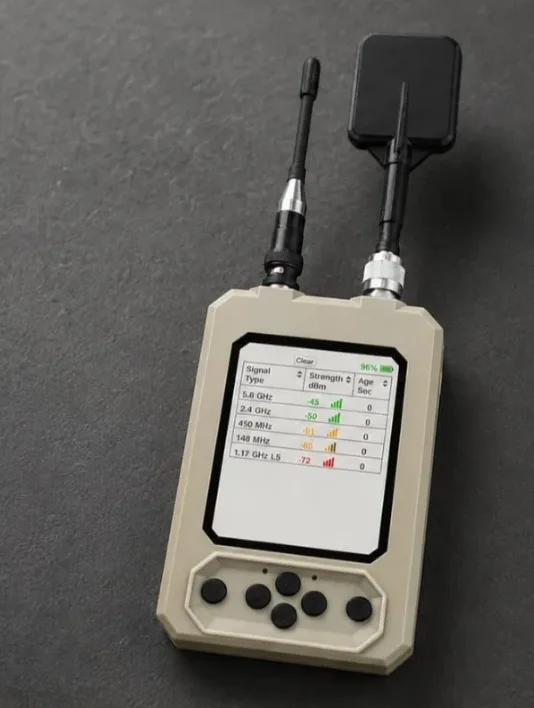
The MOTH is a passive receiver. It does not transmit and it does not interfere with anything — it listens. Working from published vendor material, it monitors RF activity across roughly 5 MHz to 6 GHz and helps the operator decide whether something abnormal is on the air: the frequency, signal strength, direction and waveform character of each emitter. Drone control links, two-way radios, anything that transmits shows up.
- Coverage: approx. 5 MHz – 6 GHz (vendor-reported)
- Weight and size: 0.99 lb (≈450 g), 5.78 × 3.3 × 1.8 in (vendor-reported)
- Carry: in hand, or strapped to a vest
- Built in: GPS, vibration alerts, a direction-finding mode, real-time spectrum display
- Interop: connects to ATAK, so RF observations land on the tactical map
- Environment: IP67, −10 °C to +55 °C (vendor-reported)

A note on evidence: we have not tested this unit. Every figure above is vendor-reported or taken from the contract announcement, checked September 2026.
Is it just a ruggedized RTL-SDR?
Fair question, and the honest answer is “partly”. Think of the MOTH as what the RTL-SDR ecosystem looks like after it grows up and joins the infantry. Both are wideband receivers that make the invisible spectrum visible. An RTL-SDR dongle is an exploration tool — cheap, ideal for learning radio, fine for scanning broadcast, airband, ham and digital signals. The MOTH packs wideband reception, a real-time spectrum display, signal analysis, direction finding, GPS and a tactical data interface into one sealed unit.
The difference that matters is the last step. The MOTH is built so a non-specialist can read the result quickly: is this band abnormal, where is the emitter, does that waveform look like a drone link. An RTL-SDR gives you a waterfall and expects you to know what to do with it.
Who carries one
Not everybody. The MOTH will not be issued like a personal radio. It is a portable electronic-reconnaissance asset, used to find, identify and locate transmitters — an enemy drone link, a concealed radio. Expect it with scouts, special operations forces, electronic-warfare personnel and squad leaders first, not one per soldier.
The price, and what is in the box
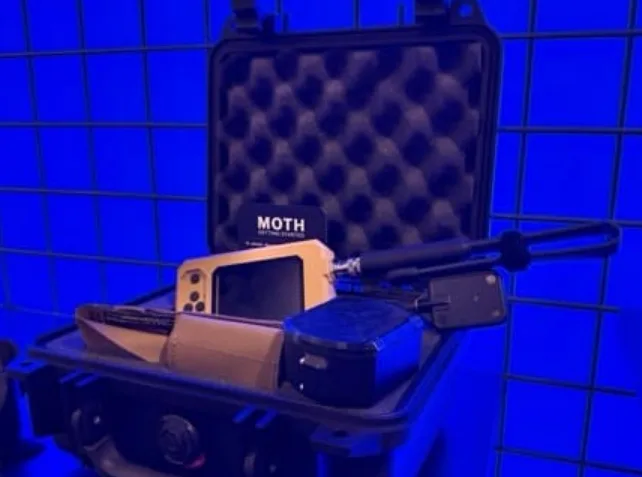
The MOTH is also on the civilian market: Lumenier lists it at $4,950 (checked September 2026). The set includes the analyzer, two batteries, a USB-C charger, a vest-style pouch, a protective case and a pair of antennas — one for the low band, one for the high band.
What this means if you are buying detection equipment
We have not tested the MOTH and this article is contract reporting plus published specifications — nothing more. Still, the purchase confirms a pattern we keep explaining to clients: professional buyers treat RF-spectrum listening and Remote ID reception as two separate layers, and budget for them separately. A spectrum analyzer hears that something is transmitting; a Remote ID receiver tells you who it is. Most sites we advise end up needing both, in that order.
| If your concern is… | RID receiver | RF spectrum analyzer |
|---|---|---|
| Drones that broadcast Remote ID | Sees them — ID and position | Sees a signal, no identity |
| FPV, modified or silent aircraft | Blind | Detects the transmission |
| False alarms | Low | Higher — 2.4/5.8 GHz bands are shared with Wi-Fi |
| Typical budget | $129–2,500 | $3,500–15,000 |
If the MOTH contract says anything to a non-military buyer, it is this: passive RF listening has moved from a hobby project to standard procurement. The same two-layer logic applies at prison fences, airports and event perimeters — at civilian budgets.
Go deeper: how RF-spectrum detection works, in plain terms → Spectrum detection explained. Shortlist hardware → receiver candidates, with sources and dates. Not sure which layer your site needs? Start with the free screening, answer within one business day.
Content last reviewed: 2026-09-11. Sources: US Army contract announcement (August 27, 2026); Heaviside Industries and Lumenier public product material (vendor-reported).